Calorie Tracking
How to Track Calories Accurately: The Complete Guide
Most calorie tracking has significant systematic errors that cancel out the benefit of tracking. This guide covers the most common sources of error, how to eliminate them, and how to hit your calorie goal without logging every meal individually.
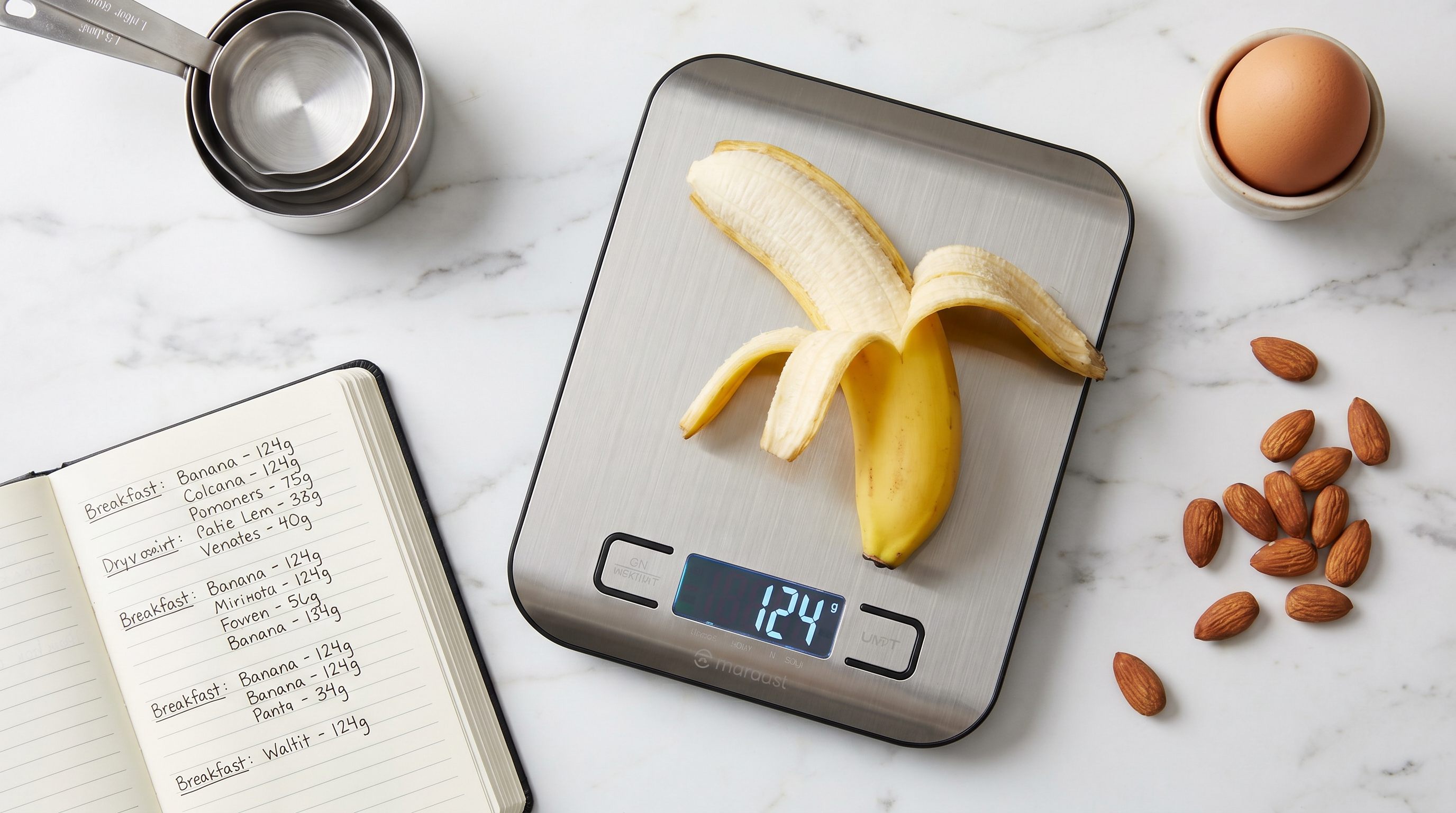
Short Answer
The most accurate way to track calories: weigh food raw on a digital food scale (not by volume), use USDA FoodData Central for calorie values (not label estimates), and weigh oils and fats which are systematically underestimated by visual portion. If you do not want to weigh food, the most accurate alternative is a structured meal plan where you cook specific recipes repeatedly -- the calories per serving are fixed and predictable once verified.
The 5 Most Common Calorie Tracking Errors
People who track calories and still do not lose weight usually have one or more of these systematic errors. Each one appears small in isolation but adds up to a meaningful daily undercount.
| Error | Typical undercount | Fix |
|---|---|---|
| Estimating oil/fat by eye | 60-120 cal per meal (a "drizzle" is 2-3x a measured tablespoon) | Weigh oils in grams (1 tbsp olive oil = 14g = 119 cal) |
| Tracking cooked weight instead of raw weight | 20-40% undercount for proteins (cooked chicken weighs less due to moisture loss) | Weigh raw before cooking, or use raw-weight values in your database |
| Not tracking beverages (coffee with milk, juice, alcohol) | 100-400 cal/day for many people | Log everything you drink that has calories; switch to black coffee |
| Using inaccurate restaurant calorie estimates | 18-25% average undercount; up to 50% for some dishes | Build your tracking around home-cooked meals; treat restaurant meals as maintenance days |
| Forgetting BLTs (bites, licks, tastes while cooking) | 100-300 cal/day for frequent cooks | No practical fix other than awareness; a small daily buffer (50-100 cal) accounts for this |
Food Scale vs. Volume Estimation: The Accuracy Gap
The most consequential decision in calorie tracking is whether to weigh food or measure by volume. The gap in accuracy is large for high-calorie-density foods:
| Food | Volume estimate calories | Actual scale calories | Typical error |
|---|---|---|---|
| Peanut butter (1 tbsp by spoon) | 94 cal | 140-180 cal | +50-90 cal (heaped spoon vs. level) |
| Olive oil (1 tbsp by pouring) | 119 cal | 180-240 cal | +60-120 cal (pouring = 1.5-2 tbsp) |
| Almonds (1 oz handful) | 164 cal | 200-230 cal | +40-65 cal (a handful = 1.2-1.4 oz) |
| Chicken breast (1 cooked breast) | 165 cal | 200-280 cal | +35-115 cal (breast sizes vary widely) |
| Rice (1 cup cooked) | 206 cal | 195-220 cal | Relatively accurate for grains |
| Avocado (half) | 115-130 cal | 100-200 cal | +/-50-70 cal (avocado size varies 2x) |
For vegetables and leafy greens, volume estimation is accurate enough (calorie density is so low that errors are minimal). For nuts, oils, cheese, protein portions, and nut butters, use a scale.
An Alternative to Daily Tracking: Structured Meal Planning
If you find daily calorie logging unsustainable, structured meal planning achieves the same calorie control through a different mechanism. Instead of logging what you eat after the fact, you plan what you will eat in advance, verify the calorie total of that plan, and then follow it. Once you know the calorie count of a specific recipe made the same way, you do not need to re-track it every time you make it.
This approach works best when: you cook at home most of the time, you have a rotation of 10-15 verified recipes, and you can identify which meals are roughly equivalent in calories when substituting. The tradeoff: it requires discipline in sticking to the plan and does not accommodate impulsive food decisions.
Find your calorie target before building a plan: Free Macro Calculator. Enter your stats to get the recommended daily calorie and macro range for your goal.
Related Reading
Frequently Asked Questions
- What is the most accurate way to track calories?
- The most accurate method is weighing food raw on a digital food scale and using USDA FoodData Central or a validated nutrition database to look up calorie values per gram. Portion estimation by volume (cups, tablespoons) is less accurate -- especially for calorie-dense foods like nuts, oils, and cheese -- because small errors in volume estimation lead to large calorie errors. For oils specifically, a "tablespoon" poured by hand is typically 1.5-2 tablespoons in practice, which represents 60-80 additional calories per pouring.
- How inaccurate are calorie counts on nutrition labels?
- FDA regulations allow a 20% margin of error on nutrition label calorie values. A food labeled 100 calories per serving can legally contain 80-120 calories. Restaurant calories are less regulated and often significantly higher than listed, with studies showing average underreporting of 18-25% across fast-casual restaurants. Home-cooked meals are generally the most accurate when portion sizes are weighed, because the ingredients' calorie counts are more verifiable than restaurant estimates.
- Do I need to track calories to lose weight?
- No, but understanding your calorie intake increases the probability of a successful weight loss attempt. Research shows that people who track their food intake consistently lose significantly more weight than those who do not, not because tracking is magic, but because it makes calorie consumption visible and prevents the unconscious underestimation that nearly all adults do when estimating portion sizes. You can also achieve a calorie deficit through structured meal planning (eating specific planned meals rather than tracking every gram), which removes the burden of daily logging.
- Does easyChef Pro help with calorie tracking?
- easyChef Pro shows the calorie and macro breakdown for every recipe before you cook it. The PLAN feature generates a full week of meals within your calorie target, so you can hit your calorie goal through structured planning rather than daily logging. The Recipe Scorer shows calories per serving for any recipe URL you import. For precise tracking, set your calorie target in the app and review the weekly total from your meal plan to see whether your planned meals match your goal.
Hit your calorie goal through planning, not daily logging
easyChef Pro builds a full week of meals within your calorie target. Cook what is planned, hit your goal. 7-day free trial, no credit card required.