Nutrition Research
New Protein Recommendations 2025: What the USDA Actually Changed
The 0.8g per kg number your app shows you is two guidelines behind. Here is what changed in January 2026 and what it means for your daily target.
Short Answer
The 2025-2030 USDA Dietary Guidelines, released January 2026, raised the general adult protein recommendation to 1.2-1.6g per kg of body weight per day. The previous 0.8g per kg figure was a deficiency floor, not a health target. Most nutrition apps still show the old number. The gap between what apps recommend and what the current guidelines say is now 50 to 100 percent.
In January 2026, the United States Department of Agriculture released the 2025-2030 Dietary Guidelines for Americans. Among several significant changes, one stands out for anyone who tracks nutrition: the recommended protein intake for adults was raised substantially.
The old figure, 0.8 grams of protein per kilogram of body weight per day, was the Recommended Dietary Allowance established by the National Academy of Medicine. It was designed to prevent protein deficiency in sedentary adults. It was never intended as an optimal target. The new guidelines acknowledge this directly and set a higher practical recommendation.
What the 2025 Guidelines Actually Say
The 2025-2030 Dietary Guidelines for Americans recommend 1.2-1.6g of protein per kg of body weight per day for general adult health. For active adults, the upper end of that range and beyond is appropriate. For people building muscle, the International Society of Sports Nutrition recommendation of 1.6-2.2g per kg still applies.
The key shift is in who the baseline recommendation applies to. The old 0.8g per kg was for sedentary adults only. The new 1.2-1.6g per kg applies to adults broadly, recognizing that most people are not fully sedentary and that higher protein intake supports muscle preservation, satiety, and metabolic health across the lifespan.
| Source | Protein target (g per kg) | Who it applies to |
|---|---|---|
| NAM RDA (unchanged) | 0.8g per kg | Sedentary adults, deficiency prevention only |
| USDA DGA 2025-2030 (new) | 1.2-1.6g per kg | General adult population |
| ACSM guidelines | 1.2-1.7g per kg | Recreationally active adults |
| ISSN Position Stand 2017 | 1.6-2.2g per kg | Adults building muscle |
The formal RDA of 0.8g per kg set by the National Academy of Medicine has not changed. The USDA Dietary Guidelines operate separately and now set a higher practical target. Most nutrition apps reference the RDA, not the DGA, which is why they still show the lower number.
What This Means in Grams Per Day
At 1.2-1.6g per kg, daily protein targets look very different from what most apps currently recommend:
| Body weight | Old target (0.8g/kg) | New target (1.2-1.6g/kg) | Difference |
|---|---|---|---|
| 130 lbs (59 kg) | 47g per day | 71-94g per day | +24 to +47g |
| 150 lbs (68 kg) | 54g per day | 82-109g per day | +28 to +55g |
| 175 lbs (79 kg) | 64g per day | 95-127g per day | +31 to +63g |
| 200 lbs (91 kg) | 73g per day | 109-145g per day | +36 to +72g |
Not sure what your exact target is? Calculate your daily protein target free based on your weight, activity, and goal. Updated to the 2025-2030 USDA guidelines.
Why the Change Happened
The research case for higher protein intake has been building for years. Several factors drove the 2025 update:
Muscle health recognition
The 2025 guidelines place greater emphasis on muscle mass as a health outcome across the lifespan, not just for athletes. Adequate protein intake is directly linked to preserving lean mass during aging, weight loss, and periods of reduced activity. The 0.8g per kg threshold was insufficient to support this outcome in most adults.
Weight management evidence
Higher protein intake during a calorie deficit (1.2-1.6g per kg) consistently outperforms lower protein intakes for preserving muscle mass while losing fat. Protein also increases satiety, which improves adherence to calorie-controlled eating. The 2025 guidelines incorporate this evidence base more explicitly than previous editions.
Healthy aging
Adults over 50 experience accelerated muscle loss (sarcopenia) at protein intakes near 0.8g per kg. Research shows intakes of 1.2-1.6g per kg significantly slow this process. With an aging population, the guidelines reflect this by setting a higher baseline that applies to all adults, not just those who are active.
How to Hit the New Target
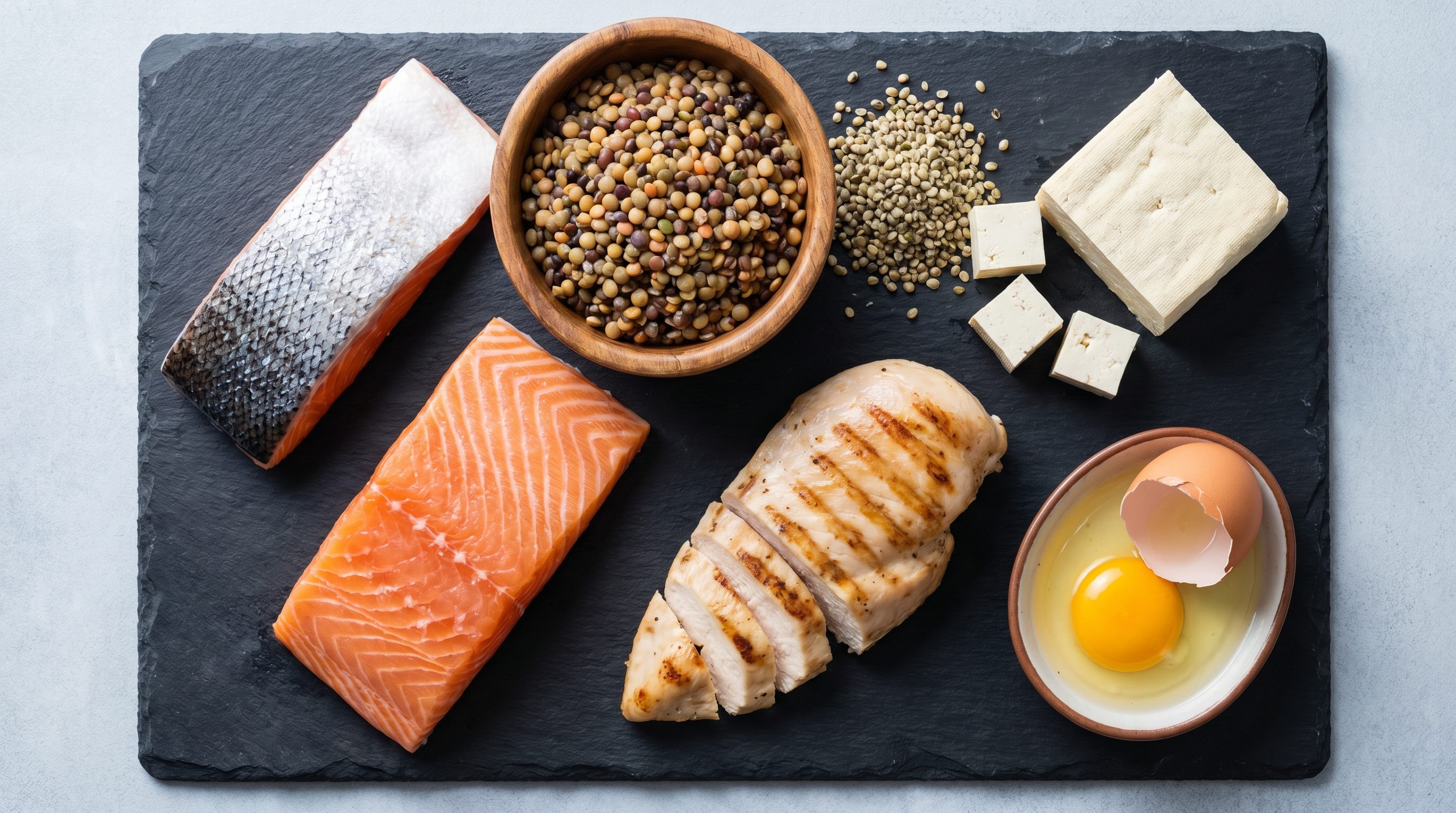
Getting to 1.2-1.6g per kg per day requires intentional food choices, particularly at breakfast and lunch, where most people fall short. The most efficient approach is to anchor each meal around a high-protein source:
| Food | Protein per 100g | Typical serving | Protein per serving |
|---|---|---|---|
| Chicken breast (cooked) | 31g | 150g | 47g |
| Canned tuna (drained) | 25g | 140g (1 can) | 35g |
| Salmon fillet (cooked) | 20g | 150g | 30g |
| Cottage cheese | 11g | 200g | 22g |
| Greek yogurt (plain) | 10g | 200g | 20g |
| Eggs (whole) | 13g | 2 large eggs | 13g |
| Lentils (cooked) | 9g | 200g | 18g |
| Edamame | 11g | 150g | 17g |
The per-meal approach
For a 160-pound (73kg) person targeting 110g per day, spreading across 3 meals means roughly 35-40g per meal. That is achievable with a chicken breast at lunch, salmon at dinner, and Greek yogurt plus eggs at breakfast. The challenge is not the individual meals but the consistency across the week.
What Apps Are Getting Wrong
Most nutrition tracking apps set protein targets based on the NAM RDA of 0.8g per kg because it is the most widely cited single number. When you set your goal to "maintain weight" in most apps, the protein target you see is roughly 0.36g per pound of body weight, which translates to 0.8g per kg.
The problem is that this number is now nearly double what the current USDA guidelines recommend for general adult health. A 170-pound person following their app's protein recommendation is eating 62g of protein per day. The 2025 guidelines say they should be eating 93-124g.
easyChef Pro's protein calculator and macro calculator have been updated to reflect the 2025-2030 USDA Dietary Guidelines. If your current app shows a target near 0.5g per pound, it has not been updated.
See your updated target: Calculate your macros with the 2025 USDA guidelines built in. Select your diet type and health focus for a personalised split.
Related Reading
Frequently Asked Questions
- What is the new protein recommendation for 2025?
- The 2025-2030 USDA Dietary Guidelines, released January 2026, raised the general adult protein recommendation to 1.2-1.6g per kg of body weight per day. This is a significant increase from the previous 0.8g per kg minimum, which was designed only to prevent deficiency, not to support muscle health, weight management, or active lifestyles.
- Why did the USDA raise the protein recommendation?
- The update reflects decades of research showing that 0.8g per kg was too low for most adults. Studies consistently show that 1.2-1.6g per kg better supports muscle preservation, satiety, metabolic health, and healthy aging. The ISSN had been recommending higher intakes since 2017. The 2025-2030 DGA brings the federal recommendation in line with the current evidence base.
- How much protein do I need per day under the new 2025 guidelines?
- It depends on your body weight. At 1.2-1.6g per kg: a 130-pound (59kg) person needs 71-94g per day. A 160-pound (73kg) person needs 87-116g per day. A 190-pound (86kg) person needs 104-138g per day. Active adults and people building muscle need the higher end of that range.
- Is 0.8g of protein per kg still the recommendation?
- 0.8g per kg remains the formal Recommended Dietary Allowance (RDA) set by the National Academy of Medicine, which sets the minimum to prevent deficiency. The 2025-2030 USDA Dietary Guidelines now go further and recommend 1.2-1.6g per kg as the practical target for general adult health. Most apps still default to 0.8g per kg and have not been updated.
- What foods help me hit the new protein targets?
- High-protein foods that help reach 1.2-1.6g per kg targets: chicken breast (31g per 100g), Greek yogurt (10g per 100g), cottage cheese (11g per 100g), eggs (13g per 100g), canned tuna (25g per 100g), salmon (20g per 100g), lentils (9g per 100g cooked), edamame (11g per 100g). Spreading intake across 3-4 meals of 25-40g each is more effective than hitting the target in one or two meals.
Calculate your protein target with the 2025 guidelines
Enter your weight, activity, and goal. Get your updated daily protein target in 20 seconds. Free. No account required.