Guide
Glycemic Index: What It Is and How It Works
Quick Answer
The glycemic index (GI) ranks foods that contain carbohydrate by how much they raise blood glucose in a test, compared with a reference food. A food with a GI of 55 or less is called low, 56 to 69 medium, and 70 or more high. easyChef Pro's Glycemic Impact Score is a different measure: it estimates the blood-sugar impact of a whole recipe from its fiber-to-carb ratio, its sugar-to-carb ratio and its NOVA processing level, and it uses no GI values.
What the glycemic index is
The glycemic index is a ranking of carbohydrate foods on a scale from 0 to 100 by how quickly they raise blood sugar after eating, according to Diabetes UK (page reviewed 22 September 2025). The University of Sydney GI site describes it as a ranking "according to the extent to which they raise blood sugar (glucose) levels after eating", set against an equal-carbohydrate portion of the reference food, glucose (glycemicindex.com). The Linus Pauling Institute at Oregon State University calls it "a measure of the blood glucose-raising potential of the carbohydrate content of a food" (LPI).
How GI is measured
GI values come from tests, not from recipes. In a typical test, healthy volunteers eat a portion of the food that contains 50 grams of available carbohydrate, and their blood glucose is followed over time. Each person's response is compared with their own response to the reference food on another day, and the food's GI is the average. The University of Sydney describes tests with 10 or more healthy people (glycemicindex.com); the Linus Pauling Institute describes the same 50-gram comparison (LPI). Sources differ on the exact number of volunteers, so a GI is a tested value for one food as tested, not a property of every version of it.
Low, medium and high
Diabetes UK uses three bands (Diabetes UK):
| Band | GI | What the source says |
|---|---|---|
| Low | 55 or below | raises blood sugar slowly |
| Medium | 56 to 69 | raises blood sugar at a medium rate |
| High | 70 or more | raises blood sugar quickly |
The Linus Pauling Institute uses the same cut-offs (LPI).
What the glycemic index does not tell you
Diabetes UK notes that GI does not take portion size into account, that not all low-GI foods are healthy choices, and that not all high-GI foods are unhealthy ones (Diabetes UK). A GI says how quickly a carbohydrate food raises blood sugar in a test; it says nothing about portion size, other nutrients or whether a food is healthy.
How to look up the glycemic index of a food
If you want the GI of a particular food, look it up where it was measured. The University of Sydney runs a searchable database of tested foods: the glycemicindex.com GI search. The Linus Pauling Institute publishes a table with serving sizes and glycemic loads: the LPI glycemic index and glycemic load page. Diabetes UK lists example foods in each band, without numbers: Diabetes UK's list of foods by GI band.
A GI value comes from a test of a food, not from a recipe, so a recipe you cook has no GI value of its own. The next sections explain how glycemic load adds portion size, and how easyChef Pro's Glycemic Impact Score estimates the blood-sugar impact of a whole recipe.
Glycemic index and glycemic load
Glycemic load combines the GI rating with the amount of carbohydrate in a serving (Diabetes UK). The Linus Pauling Institute describes it as accounting for "both the quality (GI) and quantity of carbohydrate in a serving", and bands a serving's glycemic load as low at 10 or less, intermediate at 11 to 19 and high at 20 or more (LPI). A food can have a high GI and a small carbohydrate serving, which is why the two numbers can disagree.
Why two foods with the same carbohydrate can differ
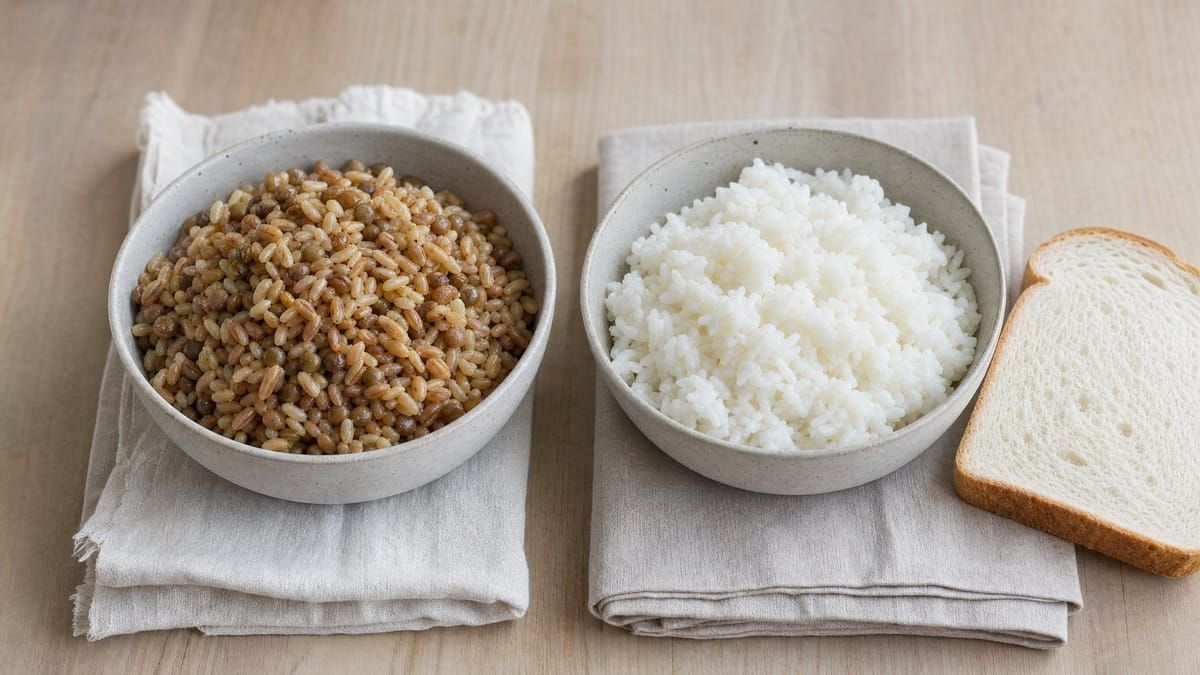
Several things change a food's GI, according to Diabetes UK (source): how it is cooked (frying, boiling and baking), how it is processed (milling, pureeing), the ripeness or variety of fruit and vegetables, and the protein, fat and fiber that come with it. The GI value relates to a food eaten on its own. The Linus Pauling Institute adds that in a mixed meal the amounts and types of carbohydrate, fat and protein change the result, and that one study found a meal's GI estimated from its individual foods was off by 22 to 50 percent (LPI).
Foods the sources list by band
We do not publish a GI table. The most cited one, the Linus Pauling Institute's, forbids copying its table, so open it on their page for the numbers, with serving sizes and glycemic loads. Diabetes UK lists examples by band without numbers (source): among low-GI foods it names strawberries, raspberries, pears, apples, oranges, grapes, dried apricots, carrots and lentils; among medium, cantaloupe melon, pineapple, overripe bananas, sweet potato and couscous; among high, refined carbohydrates such as white bread, regular potatoes, doughnuts, bagels and watermelon.
These are Diabetes UK's examples; to look up the number for a food, use the search and table linked above.
How easyChef Pro's Glycemic Impact Score is different
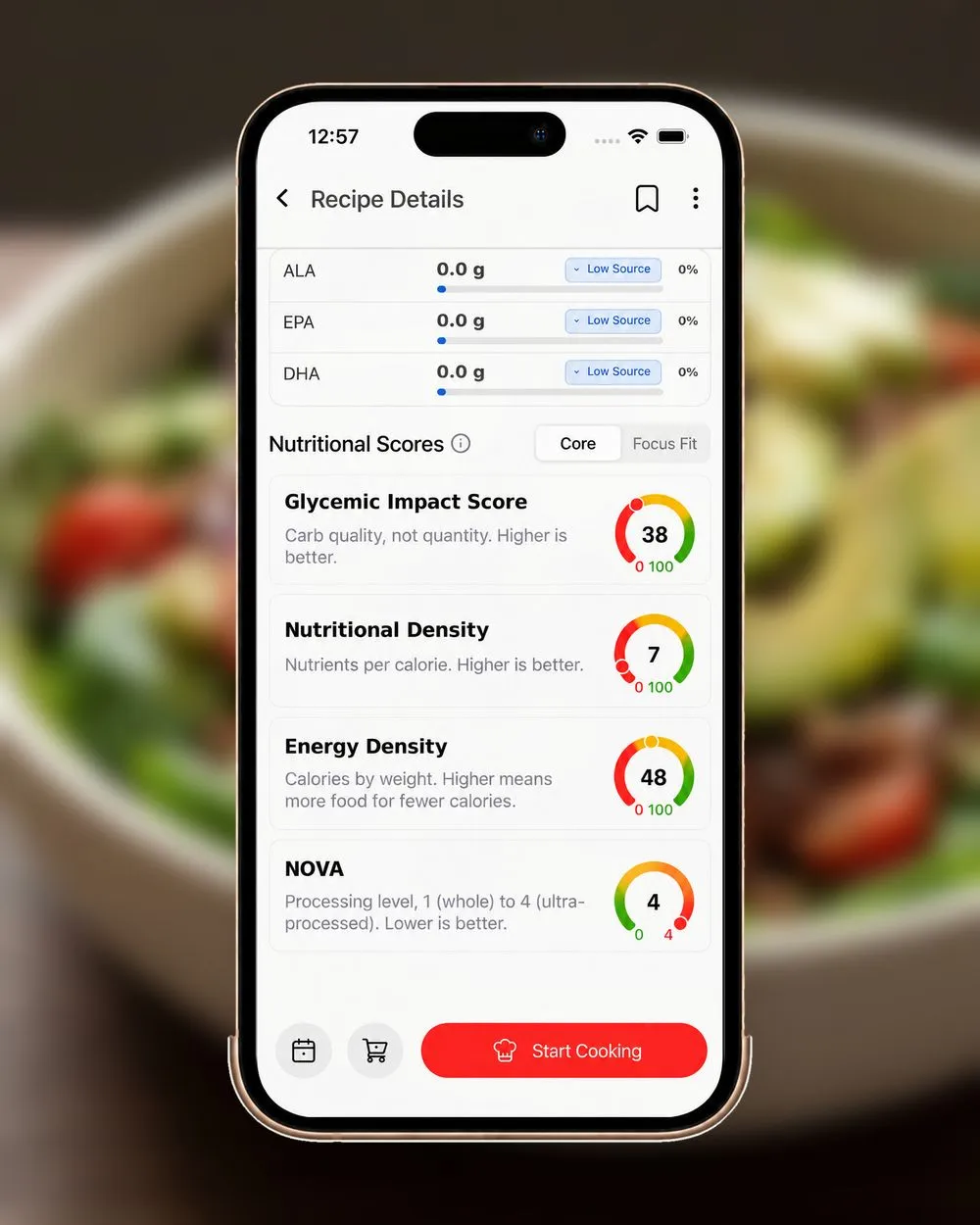
A glycemic index belongs to a tested food. The Glycemic Impact Score belongs to a recipe: easyChef Pro estimates the blood-sugar impact of the whole recipe from three things in it: its fiber-to-carb ratio, its sugar-to-carb ratio and its NOVA processing level. It runs from 0 to 100, and higher is better. It is not a glycemic index, it does not use GI values or glycemic load, and it is not a medical rating: it does not diagnose or prescribe.
| Glycemic index | Glycemic Impact Score | |
|---|---|---|
| What it rates | A tested food | A whole recipe |
| Where the number comes from | Tests on healthy volunteers | The recipe's own ingredients and amounts |
| Inputs | Blood glucose response compared with a reference food | Fiber-to-carb ratio, sugar-to-carb ratio and NOVA processing level |
| Scale | Relative to a reference food (glucose is 100); 55 or less is called low | 0 to 100, higher is better |
| Where you see it | Published tables | The recipe nutrition calculator and the easyChef Pro app |
The Glycemic Impact Score is one of four core scores, with Nutritional Density, Energy Density and the NOVA level. Open a recipe in the easyChef Pro app to see these scores next to its full nutrition facts.
Score a recipe you cook
Paste a recipe link or type a recipe name into the free recipe nutrition calculator to see its Glycemic Impact Score with the other three core scores and six Focus Fit scores. Get the app to swap an ingredient in Remix and see every score recalculated.
Related Reading
Frequently asked questions
- What is the glycemic index?
- It ranks carbohydrate foods on a scale from 0 to 100 by how quickly they raise blood sugar after eating (Diabetes UK, reviewed 22 September 2025).
- What counts as a low glycemic index?
- 55 or below is low, 56 to 69 medium and 70 or more high (Diabetes UK; Linus Pauling Institute).
- Is glycemic index the same as glycemic load?
- No. Glycemic load combines a food's GI with the amount of carbohydrate in a serving (Diabetes UK; Linus Pauling Institute).
- Does cooking change a food's glycemic index?
- It can. Diabetes UK lists frying, boiling and baking, and processing such as milling and pureeing, among the things that change a food's GI.
- Is easyChef Pro's Glycemic Impact Score the same as glycemic index?
- No. It is a recipe-level estimate from the recipe's fiber-to-carb ratio, sugar-to-carb ratio and NOVA processing level. It uses no GI values or glycemic load.
- Is this medical advice?
- No. This guide explains a measure and what two scores are. It does not say what anyone should eat. Ask a clinician or dietitian about your own needs.
Sources
- Diabetes UK, Glycaemic index and diabetes, last reviewed 22 September 2025.
- Linus Pauling Institute, Oregon State University, Glycemic Index and Glycemic Load (updated through March 2016).
- University of Sydney, About glycemic index, glycemicindex.com (undated).
SEE THE NUTRITION
Check a Recipe Before Cooking
Paste a recipe link into easyChef Pro to see its nutrition per serving and its score. Edit an ingredient and the score updates. Add the recipes you like to a meal plan.



On a computer? Scan with your phone camera to get the app.
Score a Recipe's Glycemic Impact
Your recipe, your ingredients, your goal. Free with your email.