Nutrition Truth
Why Do Calorie Apps Give Different Numbers for the Same Food?
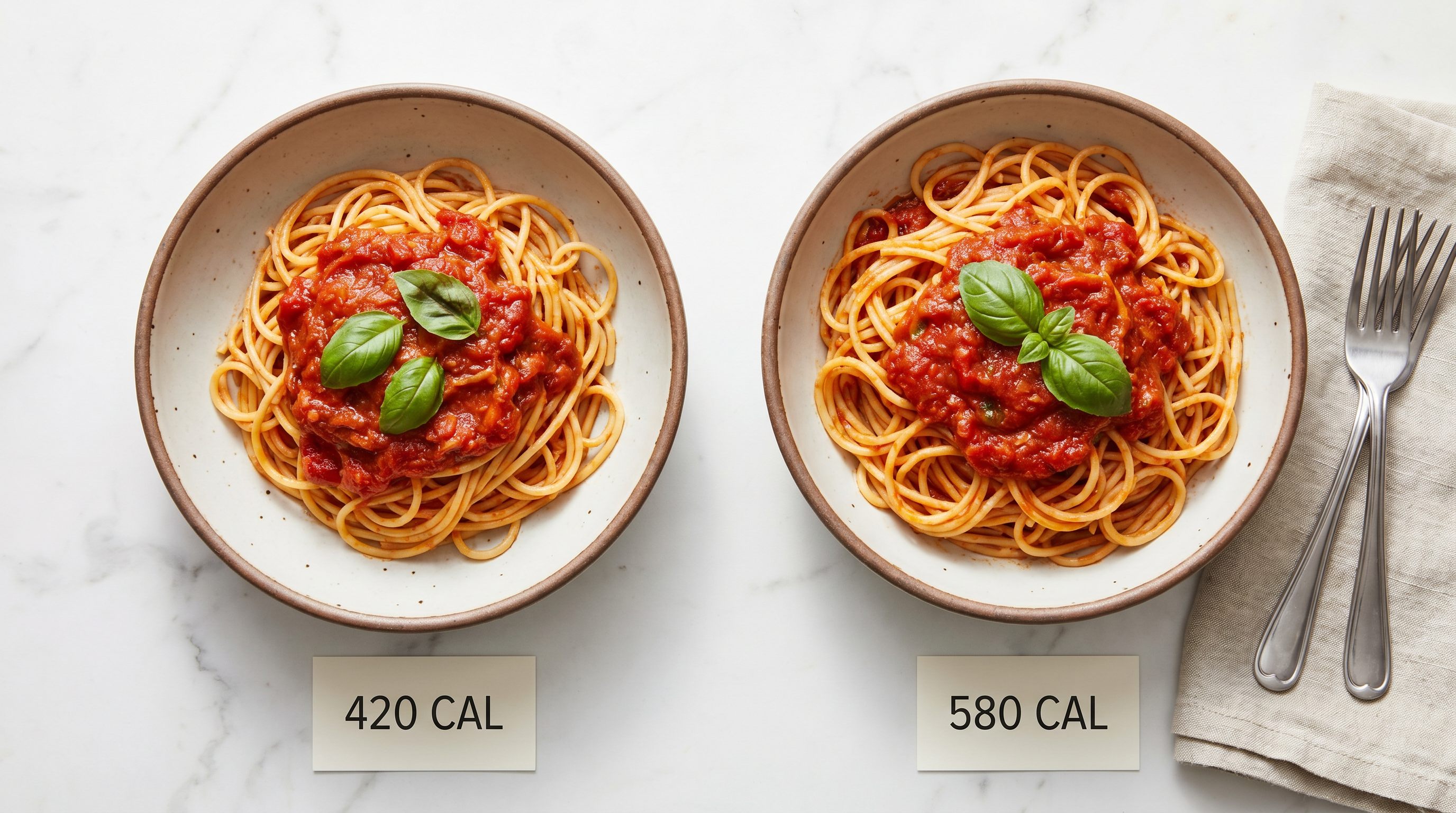
The same chicken breast. Five apps. Five different calorie counts. This is not a glitch.
Short Answer
Calorie apps give different numbers because most of them estimate. They use AI models or user-submitted data to guess what is in your food, and estimates change depending on the training data, the algorithm, and the product database. easyChef Pro calculates from 800,000+ USDA-verified products instead. Same meal, same score, every time.
Log the same chicken breast, cooked at home, in five popular calorie tracker apps. You will likely get five different calorie counts, sometimes varying by 50 to 150 calories. For a single ingredient. This is not a glitch. It is how most nutrition apps are built.
Understanding why this happens, and what the alternative is, matters if you are trying to make real food decisions based on real numbers.
Why Most Calorie Apps Estimate Instead of Calculate
1. User-submitted databases
Most calorie trackers rely on databases built partly or entirely from user submissions. When a user adds "homemade chicken breast" to the database, they are inputting a guess. That guess gets averaged with other guesses. The result is an estimate with no fixed anchor and no way to verify it.
Apps like MyFitnessPal, Lose It, and Cronometer use variants of this model. Their databases contain millions of entries, but a significant portion are user-submitted, unchecked, and inconsistent.
2. AI estimation from photos or descriptions
Some apps use AI image recognition to estimate calories from a photo of your plate. The AI model was trained on labeled food images, but cooking methods, portion sizes, and ingredient variations affect nutrition in ways a photo cannot capture. Two photos of "chicken and rice" can look identical and have nutritionally different compositions.
3. Different portion size assumptions
Even when apps use verified data, they often default to different standard portion sizes. One app might calculate a "medium apple" at 150 grams. Another uses 182 grams. A 20% difference in assumed weight creates a 20% difference in the calorie count, before any estimation error.
4. Different nutrient databases
Apps source nutrition data from different databases: USDA, branded manufacturer data, international databases, or proprietary research. Each has different values for the same food. A cooked chicken breast in the USDA FoodData Central database has different measured nutritional values than the same product in a European nutrition database.
The easyChef Pro Difference: Calculation, Not Estimation
easyChef Pro uses a deterministic nutrition scoring engine built on 800,000+ USDA-verified products. USDA FoodData Central is the federal standard for nutrition measurement in the United States, tested in controlled laboratory conditions.
What "deterministic" means: the same input always produces the same output. Log the same chicken breast tonight and in three months. The score is identical. No AI estimation. No user-submitted averaging. No drift.
The result is a 0 to 100 nutrition score built from 30+ nutritional factors that you can decompose to the exact nutrient.
| App type | Data source | Reproducible? | Score variance |
|---|---|---|---|
| User-submitted database | Crowdsourced estimates | No | Can vary 30-50% for the same food |
| AI photo estimation | Image recognition model | No | Highly variable |
| USDA-sourced (easyChef Pro) | Federal laboratory testing | Yes, always | Same input = same output |
Why This Matters for Your Health Decisions
If your app is estimating, you are making decisions based on a range, not a number. You just do not know it. A 100-calorie estimation error across three meals a day adds up to roughly 2,100 calories per week of uncertainty. That is the equivalent of an entire day of eating, invisible in your data.
More importantly, calories are only part of the picture. easyChef Pro's nutrition score accounts for 30+ factors including glycemic impact, fiber-to-carb ratio, omega-3 content, sodium, saturated fat, and processing level, each weighted differently depending on your health goal.
A meal that scores 72 for General Wellness might score 38 for Heart Health (because of sodium) or 79 for Performance (because of protein density). No calorie counter gives you that.
The Six Health Focus Profiles
easyChef Pro calculates six different scores for every recipe, one for each health goal:
- General Wellness - balanced across all nutritional factors. The default starting point.
- Heart Health - optimised for sodium, saturated fat, fiber, and potassium.
- Metabolic - addresses blood sugar impact, glycemic load, and fiber-to-carb balance.
- Digestive Health - focuses on fiber, probiotics, and gut-friendly ingredients.
- Inflammatory - covers omega-3 content, processing level, and nutrient density.
- Performance - prioritises protein percentage, energy density, and recovery nutrition.
Your calorie app gives you one number. easyChef Pro gives you six scores, each calculated from USDA data for the goal you are actually working toward.
Frequently Asked Questions
- Why do different nutrition labels show different calories for the same product?
- Manufacturer nutrition labels are legally permitted a 20% margin of error in the US. That means a product labeled 200 calories could legally contain anywhere from 160 to 240 calories. This is why easyChef Pro uses USDA FoodData Central, a federally tested and verified database, rather than manufacturer-submitted label data.
- Is there a calorie app that gives the same answer every time?
- easyChef Pro calculates from 800,000+ USDA-verified products using a deterministic engine. The same meal, the same goal, the same score every time. No AI estimation. Real math.
- Why did I log the same meal in two apps and get different macros, not just calories?
- Different apps use different databases, different portion size assumptions, and different methods for handling mixed dishes. There is no universal standard for user-submitted nutrition databases. USDA FoodData Central is the closest thing to a verified standard available.
- What is the most accurate nutrition tracking app?
- Accuracy depends on data source and method. Apps that calculate from USDA-verified data are more accurate than apps relying on user-submitted databases or AI estimation. easyChef Pro uses USDA FoodData Central for its 800,000+ product database and applies a deterministic scoring engine.
Try It Yourself
Score any recipe free. No account required.