Traditional Salt-Risen Loaf
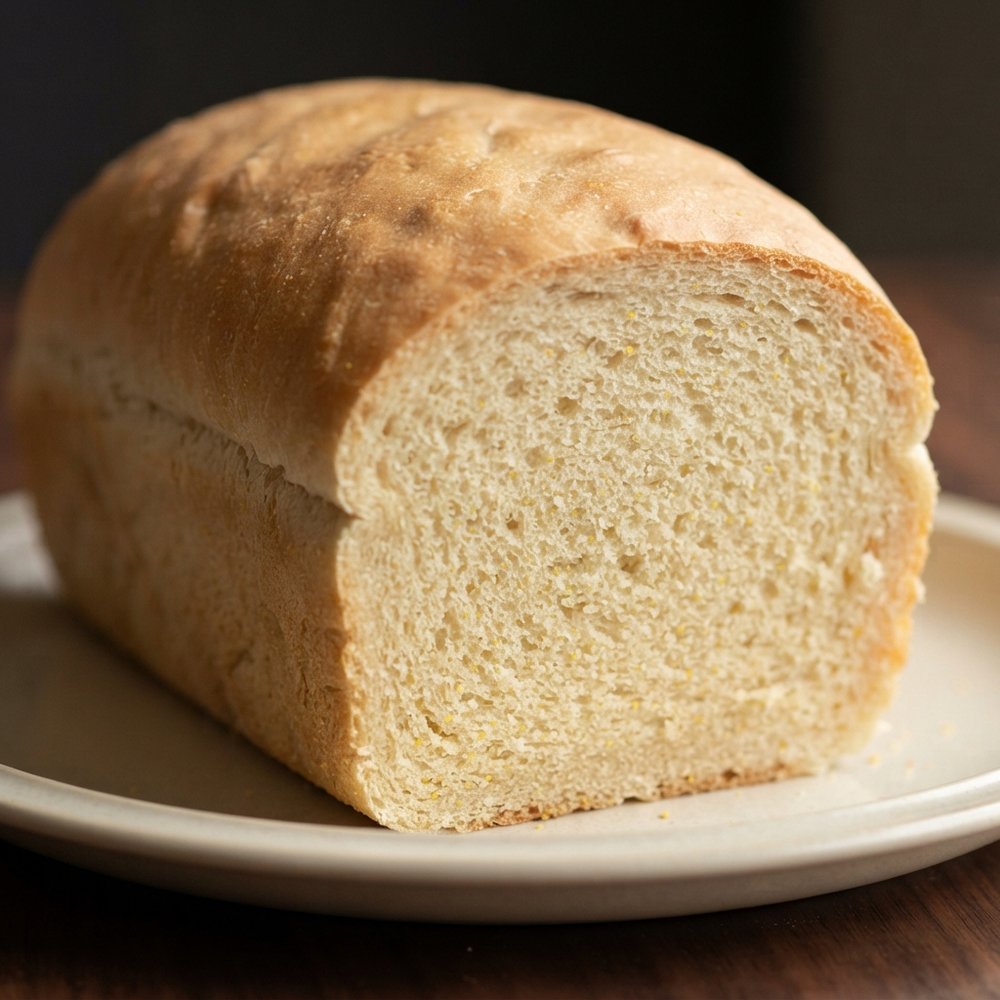
Traditional Salt-Risen Loaf delivers a uniquely aromatic crumb with subtle tang and a tender, close texture. Built from a warm-fermented cornmeal starter instead of commercial yeast, it develops rich, buttery notes and a nostalgic bakery aroma. Serve for breakfast toast, sandwich slices, or alongside soups when you want an old-time, distinctive bread.
- Prep20 mins
- Cook30 mins
- Serves36
- DifficultyHard
easyChef Pro health score
Calculated from USDA-referenced nutrient data for the ingredients in Traditional Salt-Risen Loaf, not estimated by an AI model. The same recipe returns the same score every time.
- Glycemic ImpactFair
- 48 / 100
- Carb quality, not quantity. Higher is better.
- Nutritional DensityPoor
- 5 / 100
- Nutrients per calorie. Higher is better.
- Energy DensityFair
- 56 / 100
- Calories by weight. Higher means more food for fewer calories.
- NOVA Processed Culinary Ingredients
- 2 / 4
- Processing level, 1 (whole) to 4 (ultra-processed). Lower is better.
How it scores for each health goal
The same recipe scores differently against different goals, because the goal changes the calculation rather than filtering a list. Set your goal in easyChef Pro and every recipe is scored against it.
- 72
- Heart Health
- 55
- Metabolic
- 15
- Digestive
- 36
- Inflammatory
- 21
- Performance
- 33
- General Wellness
- 1
To make the starter, heat the milk, then stir in 1 tablespoon of the sugar, the cornmeal, and 1 teaspoon of the salt. Place this mixture in a jar and set it in an electric skillet or slow cooker filled with hot water. Keep the temperature between 105 and 115 degrees F (40 to 47 degrees C) for 7 to 12 hours, or until there are signs of fermentation. You can hear gas escaping when it has fermented enough. The foamy bubbles that form on top of the starter may take up to 24 hours. Do not proceed with making the bread until the starter reacts. As it ferments, the distinctive salt-rising aroma will develop.
- 2
When the starter is bubbly, begin the sponge. Transfer the starter mixture to a medium bowl. Stir in 2 cups of the warm water, 2 tablespoons of the sugar, the shortening, and 2 cups of the all-purpose flour. Beat the sponge thoroughly. Return the bowl to the warm water to keep the temperature steady at 105 to 115 degrees F (40 to 47 degrees C). Cover and let it rise until light and full of bubbles; this takes 2 1/2 to 3 hours.
- 3
Dissolve the baking soda in 1 tablespoon of the warm water and add it to the sponge. Stir 5 1/4 cups of the flour into the sponge, then knead in more flour as needed. Knead the dough for 10 minutes, or until smooth and workable. Divide the dough into 3 portions. Shape the dough and place it in three greased 9x5x3-inch pans. Put the covered pans in warm water, or place the uncovered pans in a warm oven with a bowl of hot water, keeping the temperature at 85 degrees F (30 degrees C). Let the bread rise until it is about 2 1/2 times its original size, which takes about 5 hours; the loaves will round to the tops of the pans.
- 4
Preheat the oven to 375 degrees F (190 degrees C).
- 5
Bake the bread at 375 degrees F (190 degrees C) for 10 minutes. Lower the oven temperature to 350 degrees F (175 degrees C) and bake for another 20 minutes, or until light golden brown. To dry a salt-rising culture, save 1/4 cup of a successful sponge and pour it into a saucer, cover with cheesecloth, and let it dry. Store the dried flakes in plastic in a cool, dry place, or freeze until needed for salt-rising bread. When ready to make the bread, dissolve the flakes in the new warm starter and continue with the recipe to boost the bread’s flavor.
- Calories 42.83 kcal Low Source 2%
- Protein 0.89 g Low Source 2%
- Carbohydrate 9.24 g 3%
- Total Fat 0.16 g Low Source 0%
- Saturated Fat 0.0 g Low Source 0%
- Trans Fat 0.04 g High --
- Cholesterol 0.0 mg Low Source 0%
- Sodium 3.05 mg Low Source 0%
- Dietary Fiber 0.78 g Low Source 3%
- Total Sugars 2.0 g --
- Added Sugars 0.55 g Low Source 1%
- Calcium 0.21 mg Low Source 0%
- Iron 0.41 mg Low Source 2%
- Potassium 9.5 mg Low Source 0%
- Vitamin A 0.16 mcg Low Source 0%
- Vitamin C 0.0 mg Low Source 0%
- Vitamin D 0.0 mcg Low Source 0%
Values are per serving. Percent Daily Values are based on a 2,000-calorie diet.
- Milk 🥛
- Wheat 🌾
- Gluten
- Corn 🌽
About This Recipe
Traditional Salt Risen Loaf is made with 8 ingredients and serves 36. It takes about 50 mins and is rated hard. Key ingredients include All Purpose Flour, Baking Soda, Cornmeal, and Milk. Each serving provides about 42.83 kcal.
Recipe Questions
- What is Traditional Salt-Risen Loaf made of?
- The main ingredients are All-Purpose Flour, Baking Soda, Cornmeal, Milk, Salt. The full list of 8 is above.
- How long does it take to make Traditional Salt-Risen Loaf?
- About 50 mins in total: 20 mins to prepare and 30 mins to cook.
- How many calories are in one serving?
- One serving provides about 42.83 kcal. The full nutrition breakdown is above.
- Is Traditional Salt-Risen Loaf easy to make?
- This recipe is rated hard, with 8 ingredients and 5 steps.
- Is Traditional Salt-Risen Loaf healthy?
- Traditional Salt-Risen Loaf has an easyChef Pro health score of 40/100. Per serving, it provides 42.83 calories and 0.89 g of protein, or 2% of the Daily Value. It contains Milk, Wheat, Gluten and Corn, so it may not be suitable for people with those allergies or dietary restrictions. Whether it fits your goals depends on your complete meal plan and nutritional needs. Remix it in easyChef Pro to adjust the ingredients and generate fresh nutrition and scores.
How easyChef Pro scores recipes and products
easyChef Pro analyzes up to 41 nutrients using data sourced from USDA and other verified food databases. Its scoring method uses the nutrients relevant to nutrition quality, calorie density, processing level, and your selected health goal. Recipes and food products get a health score from 0 to 100, calculated using consistent rules instead of being estimated by AI. The same nutrition data, serving size and health goal will produce the same result.
The calculation evaluates nutrients, calorie density, processing level, and how well the food supports your selected health goal. Protein, fiber, vitamins, minerals and other beneficial nutrients can strengthen the score. High amounts of sodium, saturated fat, added sugar and other nutrients may lower it.
Your health goal also matters. easyChef Pro evaluates recipes and products across six health areas and adjusts their importance for your selected goal. This means the same food may be a better fit for one health goal than another.
For recipes, changing an ingredient, quantity or serving size changes the nutrition and may change the score. Remix the recipe in easyChef Pro to calculate fresh nutrition and scores for the version you actually make. Product scores are based on the nutrition and serving information associated with that specific product.
Score a recipe free, no app required