Schnitzbrot (German Christmas Bread)
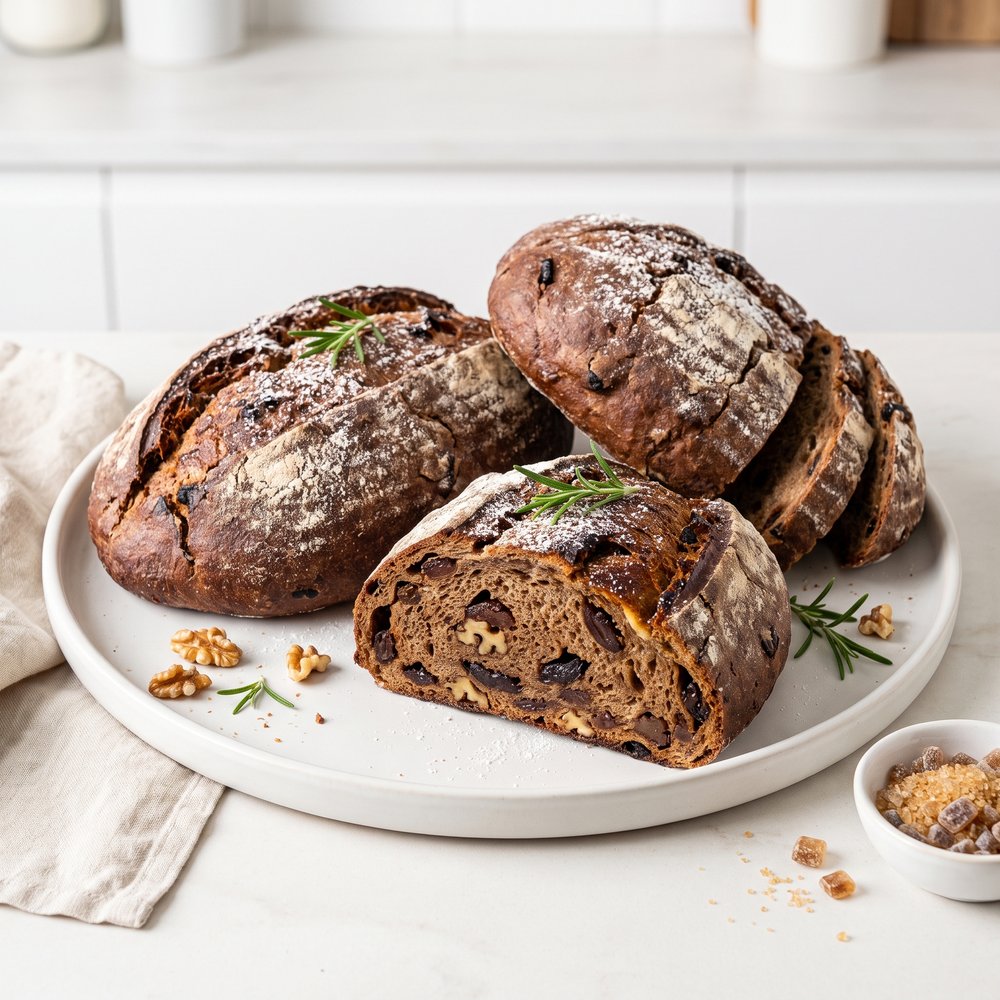
Schnitzbrot (German Christmas Bread) is a moist, fruit-and-nut loaf with a deep caramel-fruity sweetness from prune juice, prunes, raisins, and brown sugar, balanced by toasty walnuts. The enriched yeast dough bakes into tender slices that shine on holiday platters, perfect with coffee or mulled wine and even better after a day’s rest as the flavors meld.
- Prep30 mins
- Cook1 hr 40 mins
- Serves24
- DifficultyMedium
easyChef Pro health score
Calculated from USDA-referenced nutrient data for the ingredients in Schnitzbrot (German Christmas Bread), not estimated by an AI model. The same recipe returns the same score every time.
- Glycemic ImpactFair
- 42 / 100
- Carb quality, not quantity. Higher is better.
- Nutritional DensityPoor
- 16 / 100
- Nutrients per calorie. Higher is better.
- Energy DensityPoor
- 36 / 100
- Calories by weight. Higher means more food for fewer calories.
- NOVA Processed Culinary Ingredients
- 2 / 4
- Processing level, 1 (whole) to 4 (ultra-processed). Lower is better.
How it scores for each health goal
The same recipe scores differently against different goals, because the goal changes the calculation rather than filtering a list. Set your goal in easyChef Pro and every recipe is scored against it.
- 68
- Heart Health
- 64
- Metabolic
- 38
- Digestive
- 31
- Inflammatory
- 19
- Performance
- 30
- General Wellness
- 1
Lightly grease three 9x5-inch loaf pans; grease a large bowl. Set aside.
- 2
In a separate large bowl, dissolve the yeast in the water; set aside until the mixture turns creamy, about 15 minutes. Stir in the sugar until combined, then stir in 3 cups flour until well combined.
- 3
Meanwhile, combine the prune juice and mincemeat in a medium saucepan over medium heat; bring to a boil, stirring occasionally, about 1 minute. Remove from the heat, then stir in the prunes, raisins, walnuts, brown sugar, 1/2 cup butter, and salt.
- 4
Add the mincemeat mixture to the yeast mixture; gradually stir in the remaining 7 cups flour, 1 cup at a time, until well blended and a moist dough forms (you may not need all of the flour).
- 5
Turn the dough out onto a floured work surface; knead it into a ball. Transfer the dough to the greased bowl, cover with a cloth, and set aside in a warm place until doubled in volume, about 1 1/2 hours.
- 6
Punch down the dough; turn it out onto a floured work surface, knead lightly, and return it to the bowl. Set aside to rise again, about 1 hour.
- 7
Punch down the dough; turn it out onto a floured work surface and divide into 3 loaves. Place each loaf in a prepared pan; lightly brush each top with 1 teaspoon butter.
- 8
Cover the pans with a clean cloth; set aside to rise until doubled in volume, about 1 hour.
- 9
Meanwhile, preheat the oven to 300 degrees F (150 degrees C).
- 10
Bake in the preheated oven for 1 hour. Reduce the oven temperature to 250 degrees F (120 degrees C); continue baking until a toothpick inserted into the centers comes out mostly clean, about 30 minutes more. Cool slightly, remove from the pans, and cool on wire racks.
- Calories 418.71 kcal High 21%
- Protein 7.56 g Moderate 15%
- Carbohydrate 79.93 g 29%
- Total Fat 7.85 g Moderate 10%
- Saturated Fat 2.65 g Moderate 13%
- Trans Fat 0.0 g Low Source 0%
- Cholesterol 9.61 mg Low Source 3%
- Sodium 34.12 mg Low Source 1%
- Dietary Fiber 5.01 g Moderate 18%
- Total Sugars 29.13 g --
- Added Sugars 0.41 g Low Source 1%
- Calcium 28.71 mg Low Source 2%
- Iron 3.37 mg Moderate 19%
- Potassium 306.18 mg Low Source 7%
- Vitamin A 41.68 mcg Low Source 5%
- Vitamin C 0.63 mg Low Source 1%
- Vitamin D 0.0 mcg Low Source 0%
Values are per serving. Percent Daily Values are based on a 2,000-calorie diet.
- Tree Nuts 🌰
- Milk 🥛
- Wheat 🌾
- Gluten
About This Recipe
Schnitzbrot (German Christmas Bread) is a German breakfast recipe made with 12 ingredients. It takes about 2 hrs 10 mins, serves 24, and is rated medium. Key ingredients include Active Dry Yeast, All Purpose Flour, Brown Sugar, and Chopped Walnuts. Each serving provides about 418.71 kcal.
Recipe Questions
- What is Schnitzbrot (German Christmas Bread)?
- It is a German bread recipe made with 12 ingredients, usually served for breakfast or dessert or snack.
- What is Schnitzbrot (German Christmas Bread) made of?
- The main ingredients are Active Dry Yeast, All-Purpose Flour, Brown Sugar, Chopped Walnuts, Mincemeat. The full list of 12 is above.
- What goes well with Schnitzbrot (German Christmas Bread)?
- Explore these German side-dish recipes.
- How long does it take to make Schnitzbrot (German Christmas Bread)?
- About 2 hrs 10 mins in total: 30 mins to prepare and 1 hr 40 mins to cook.
- How many calories are in one serving?
- One serving provides about 418.71 kcal. The full nutrition breakdown is above.
- Is Schnitzbrot (German Christmas Bread) easy to make?
- This recipe is rated medium, with 12 ingredients and 10 steps.
- Is Schnitzbrot (German Christmas Bread) healthy?
- Schnitzbrot (German Christmas Bread) has an easyChef Pro health score of 34/100. Per serving, it provides 418.71 calories and 7.56 g of protein, or 15% of the Daily Value. Worth noting per serving: saturated fat at 2.65 g (13% of the Daily Value). It contains Tree Nuts, Milk, Wheat and Gluten, so it may not be suitable for people with those allergies or dietary restrictions. Whether it fits your goals depends on your complete meal plan and nutritional needs. Remix it in easyChef Pro to adjust the ingredients and generate fresh nutrition and scores.
How easyChef Pro scores recipes and products
easyChef Pro analyzes up to 41 nutrients using data sourced from USDA and other verified food databases. Its scoring method uses the nutrients relevant to nutrition quality, calorie density, processing level, and your selected health goal. Recipes and food products get a health score from 0 to 100, calculated using consistent rules instead of being estimated by AI. The same nutrition data, serving size and health goal will produce the same result.
The calculation evaluates nutrients, calorie density, processing level, and how well the food supports your selected health goal. Protein, fiber, vitamins, minerals and other beneficial nutrients can strengthen the score. High amounts of sodium, saturated fat, added sugar and other nutrients may lower it.
Your health goal also matters. easyChef Pro evaluates recipes and products across six health areas and adjusts their importance for your selected goal. This means the same food may be a better fit for one health goal than another.
For recipes, changing an ingredient, quantity or serving size changes the nutrition and may change the score. Remix the recipe in easyChef Pro to calculate fresh nutrition and scores for the version you actually make. Product scores are based on the nutrition and serving information associated with that specific product.
Score a recipe free, no app required