Bánh Tét
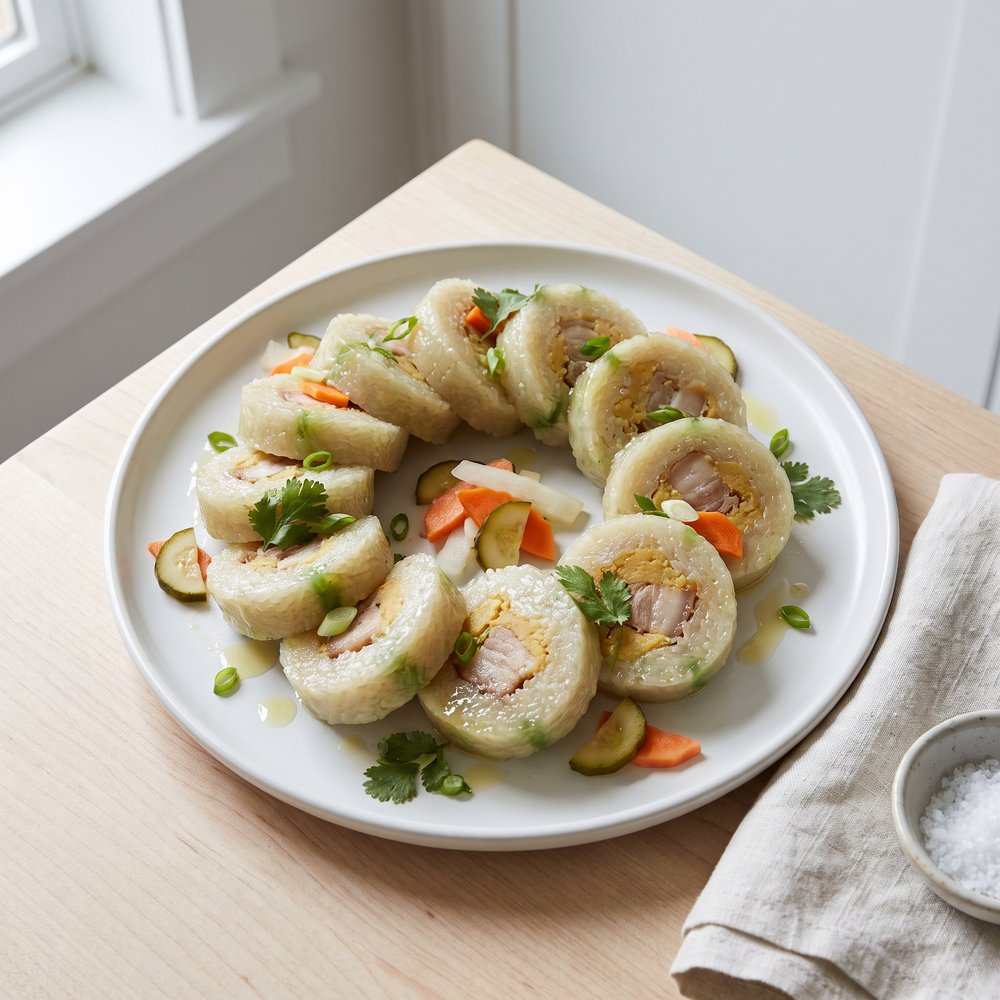
Bánh Tét is a Vietnamese sticky rice cake wrapped in banana leaf, featuring tender pork belly and velvety mung bean filling. The rice turns pleasantly chewy and aromatic while the savory-sweet pork and beans create a rich, balanced bite. Serve it sliced for Lunar New Year gatherings or festive family meals when you want something nostalgic and satisfying.
- Prep2 mins
- Cook6 mins 30 secs
- Serves12
- DifficultyHard
easyChef Pro health score
Calculated from USDA-referenced nutrient data for the ingredients in Bánh Tét, not estimated by an AI model. The same recipe returns the same score every time.
- Glycemic ImpactFair
- 54 / 100
- Carb quality, not quantity. Higher is better.
- Nutritional DensityPoor
- 0 / 100
- Nutrients per calorie. Higher is better.
- Energy DensityFair
- 42 / 100
- Calories by weight. Higher means more food for fewer calories.
- NOVA Unprocessed or minimally processed
- 1 / 4
- Processing level, 1 (whole) to 4 (ultra-processed). Lower is better.
How it scores for each health goal
The same recipe scores differently against different goals, because the goal changes the calculation rather than filtering a list. Set your goal in easyChef Pro and every recipe is scored against it.
- 19
- Heart Health
- 39
- Metabolic
- 18
- Digestive
- 20
- Inflammatory
- 18
- Performance
- 29
- General Wellness
- 1
Put the rice in a colander; rinse under cold water, stirring the rice with your fingers, until the water runs clear, about 2 minutes.
- 2
Move the rice to a large bowl or container; add enough water to cover by 2 inches. Cover and refrigerate for 12 hours.
- 3
While the rice chills, cut the pork into four 1 1/4x5-inch strips.
- 4
Put the pork strips, fish sauce, shallot, sugar, pepper, and 1/4 teaspoon salt into a large zip-top plastic freezer bag.
- 5
Seal the bag, pressing out as much air as possible. Gently massage the pork to spread the marinade.
- 6
Refrigerate for 12 hours.
- 7
Place the mung beans in a colander; rinse under cold water, stirring with your fingers, until the water runs clear, 1 to 2 minutes.
- 8
Transfer the mung beans to a small saucepan; add the remaining 1/2 teaspoon salt and 3 cups water.
- 9
Bring to a boil over high heat, stirring occasionally.
- 10
Lower the heat to medium-low and simmer, stirring occasionally, until the mung beans are creamy, no longer hold their shape, and begin to stick to the bottom of the pot, 16 to 18 minutes.
- 11
Scrape the beans into a food processor bowl.
- 12
Process until smooth, about 10 seconds.
- 13
Spread the pureed mung beans on a baking sheet.
- 14
Chill until cold, about 45 minutes. You will have about 2 cups of mung bean puree.
- 15
While the mung beans cool, gently wipe the banana leaves with a damp cloth to remove any dirt.
- 16
Using kitchen shears, trim off the fibrous strings from each banana leaf.
- 17
You only need 12 banana leaves, but you cannot use torn ones, and you should set aside wider leaves for wrapping, so have extras available.
- 18
Remove the pork from the marinade; discard the marinade.
- 19
Moisten a work surface with a damp paper towel. Lay a 14-inch-long piece of plastic wrap on the moistened surface with the long edge facing you.
- 20
Using a small offset spatula, spread 1/4 cup mung bean puree in the center of the plastic wrap to make a 6x4-inch rectangle.
- 21
Center 1 pork strip on top of the mung bean rectangle.
- 22
Spoon 1/4 cup mung bean puree over the pork, and with moistened hands, spread the puree all over the pork to mostly enclose it.
- 23
Lift the bottom edge of the plastic wrap to start wrapping the pork mixture; continue rolling into a log.
- 24
When the roll is complete, hold the plastic wrap ends and roll the pork mixture on the work surface toward you to form a tight cylinder, about 5 inches long; set the pork roll aside.
- 25
Repeat the wrapping process with the remaining 1 1/2 cups mung bean puree and the remaining 3 pork strips.
- 26
Drain the rice and move it to a large bowl. Stir in 2 1/4 teaspoons salt. You will have about 9 cups of drained rice.
- 27
Cut thirty-six 14-inch lengths and eight 28-inch lengths of kitchen twine; set aside.
- 28
Stack 3 wide banana leaves dull-side down (with the lines on the leaf running parallel to the edge of the work surface) to cover an 11-inch-wide area. You will likely need to overlap smaller leaves to make the shape.
- 29
With kitchen shears, cut the stacked leaves into an 11x14-inch rectangle, with the 11-inch side facing you; discard the trimmings and restack if needed.
- 30
Spoon 3/4 cup rice onto the center of the banana leaf stack and spread into a 6x4-inch rectangle.
- 31
Unwrap 1 pork roll and center it on the rice rectangle.
- 32
Spoon 3/4 cup rice over the pork roll.
- 33
Slowly wrap the short edge of the banana leaf stack closest to you over the pork roll, pausing to redistribute the rice enclosing the pork, until it is snug and fully wrapped.
- 34
Tie the banana leaf cylinder at the center with 1 (14-inch) piece of kitchen twine to secure.
- 35
Working with one end of the cylinder, fold the banana leaf ends over the cylinder. Hold the ends in place and stand the cylinder up on the folded end.
- 36
Spoon 1/4 cup rice into the open end; gently tap the sides of the banana cylinder and tap back and forth to settle the rice.
- 37
Seal the open end by tucking the sides of the banana leaves against the rice like wrapping a present and folding the flaps down.
- 38
Center 1 (28-inch) string over the folded end and hold the sides of the string snugly against the cylinder. Hold the folded end in place and flip the cylinder. Open the folded end.
- 39
Spoon 1/4 cup rice into the open end; gently tap the sides of the banana cylinder back and forth to settle the rice.
- 40
Seal the open end of the banana cylinder, tucking the sides of the banana leaves against the rice like wrapping a present, then fold the flaps down.
- 41
Bring the edges of the string up together and tie against the folded flaps; do not tie too tightly.
- 42
Center 1 (28-inch) string on one folded end, perpendicular to the first string, and hold the string sides snugly against the cylinder. With your other hand, hold the bottom end in place and flip the cylinder.
- 43
Bring the edges of the string up together and tie against the folded flaps; do not tie too tightly.
- 44
Lay the banana cylinder on the work surface and cut off the center string (the first one tied) with kitchen shears; discard it.
- 45
Using 5 (14-inch) pieces of kitchen twine, tie the banana cylinder from the center outward at 1 1/2-inch intervals until you reach the ends.
- 46
Wrap the banana cylinder tightly in an 18-inch-long piece of aluminum foil. Secure the center and folded ends of the foil with 3 (14-inch) pieces of kitchen twine.
- 47
Repeat the wrapping process with the remaining banana leaves, rice, pork rolls, and kitchen twine.
- 48
Place the cylinders in a large stockpot (you may need to stand them on their ends). Fill the pot with water to 2 inches below the rim.
- 49
Set a heat-proof lid on top of the cylinders to keep them submerged. Cover and bring to a boil over high heat.
- 50
Uncover and keep at a gentle boil over medium heat, turning every 2 hours, until the internal temperature reaches at least 200 degrees F (92 degrees C), about 6 hours.
- 51
Add more boiling water as needed during cooking to keep the water level 2 inches below the pot rim.
- 52
Using tongs, move the cooked banh tet to a baking sheet and let cool for at least 3 hours, or chill overnight.
- 53
Remove and discard the foil and banana leaves. Slice into rounds and serve.
- 54
For clean slices, dip the knife into warm water and wipe it clean often.
- Calories 528.0 kcal High 26%
- Protein 11.23 g Good Source 22%
- Carbohydrate 71.48 g 26%
- Total Fat 21.7 g High 28%
- Saturated Fat 7.68 g High 38%
- Trans Fat 0.0 g Low Source 0%
- Cholesterol 26.83 mg Moderate 9%
- Sodium 400.71 mg Moderate 17%
- Dietary Fiber 1.65 g Low Source 6%
- Total Sugars 4.06 g --
- Added Sugars 2.48 g Low Source 5%
- Calcium 36.65 mg Low Source 3%
- Iron 2.7 mg Moderate 15%
- Potassium 117.07 mg Low Source 2%
- Vitamin A 3.13 mcg Low Source 0%
- Vitamin C 1.77 mg Low Source 2%
- Vitamin D 0.0 mcg Low Source 0%
Values are per serving. Percent Daily Values are based on a 2,000-calorie diet.
- Fish 🐟
- Wheat 🌾
- Gluten
- Onions 🧅
About This Recipe
Bánh Tét is a Vietnamese dinner recipe made with 9 ingredients. It takes about 8 mins 30 secs, serves 12, and is rated hard. Key ingredients include Black Pepper, Fish Sauce, Mung Beans, and Pork Belly. Each serving provides about 528.0 kcal, and is a good source of protein.
Recipe Questions
- What is Bánh Tét?
- It is a Vietnamese recipe made with 9 ingredients, usually served for dinner or lunch.
- What is Bánh Tét made of?
- The main ingredients are Black Pepper, Fish Sauce, Mung Beans, Pork Belly, Sea Salt. The full list of 9 is above.
- What goes well with Bánh Tét?
- Explore these Vietnamese side-dish recipes.
- How long does it take to make Bánh Tét?
- About 8 mins 30 secs in total: 2 mins to prepare and 6 mins 30 secs to cook.
- How many calories are in one serving?
- One serving provides about 528.0 kcal. The full nutrition breakdown is above.
- Is Bánh Tét easy to make?
- This recipe is rated hard, with 9 ingredients and 54 steps.
- Is Bánh Tét healthy?
- Bánh Tét has an easyChef Pro health score of 35/100. Per serving, it provides 528.0 calories and 11.23 g of protein, or 22% of the Daily Value. Worth noting per serving: sodium at 400.71 mg (17% of the Daily Value) and saturated fat at 7.68 g (38% of the Daily Value). It contains Fish, Wheat, Gluten and Onions, so it may not be suitable for people with those allergies or dietary restrictions. Whether it fits your goals depends on your complete meal plan and nutritional needs. Remix it in easyChef Pro to adjust the ingredients and generate fresh nutrition and scores.
How easyChef Pro scores recipes and products
easyChef Pro analyzes up to 41 nutrients using data sourced from USDA and other verified food databases. Its scoring method uses the nutrients relevant to nutrition quality, calorie density, processing level, and your selected health goal. Recipes and food products get a health score from 0 to 100, calculated using consistent rules instead of being estimated by AI. The same nutrition data, serving size and health goal will produce the same result.
The calculation evaluates nutrients, calorie density, processing level, and how well the food supports your selected health goal. Protein, fiber, vitamins, minerals and other beneficial nutrients can strengthen the score. High amounts of sodium, saturated fat, added sugar and other nutrients may lower it.
Your health goal also matters. easyChef Pro evaluates recipes and products across six health areas and adjusts their importance for your selected goal. This means the same food may be a better fit for one health goal than another.
For recipes, changing an ingredient, quantity or serving size changes the nutrition and may change the score. Remix the recipe in easyChef Pro to calculate fresh nutrition and scores for the version you actually make. Product scores are based on the nutrition and serving information associated with that specific product.
Score a recipe free, no app required