Korean-Style Gimbap Rolls
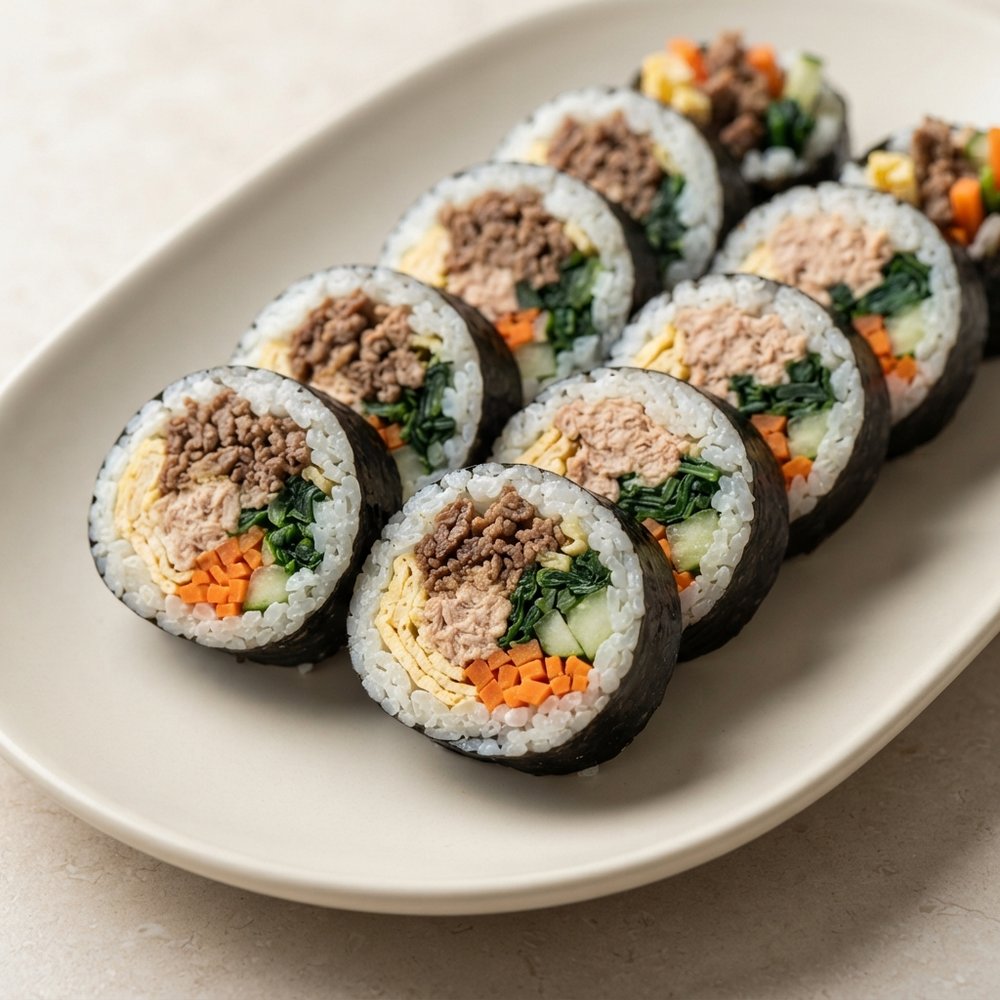
Korean-Style Gimbap Rolls balance tender minced beef, seasoned egg, and briny tuna with crisp cucumber and carrot, all tucked into glossy nori with gently vinegared rice. Each bite is clean and satisfying, with a mix of umami and fresh crunch. Serve for a light lunch, picnic spread, or party platter when you want a colorful, crowd-pleasing bite.
- Prep30 mins
- Cook30 mins
- Serves6
- DifficultyMedium
easyChef Pro health score
Calculated from USDA-referenced nutrient data for the ingredients in Korean-Style Gimbap Rolls, not estimated by an AI model. The same recipe returns the same score every time.
- Glycemic ImpactFair
- 54 / 100
- Carb quality, not quantity. Higher is better.
- Nutritional DensityPoor
- 6 / 100
- Nutrients per calorie. Higher is better.
- Energy DensityGood
- 90 / 100
- Calories by weight. Higher means more food for fewer calories.
- NOVA Unprocessed or minimally processed
- 1 / 4
- Processing level, 1 (whole) to 4 (ultra-processed). Lower is better.
How it scores for each health goal
The same recipe scores differently against different goals, because the goal changes the calculation rather than filtering a list. Set your goal in easyChef Pro and every recipe is scored against it.
- 30
- Heart Health
- 35
- Metabolic
- 23
- Digestive
- 28
- Inflammatory
- 46
- Performance
- 46
- General Wellness
- 1
In a medium saucepan, bring 2 cups water and cider vinegar to a boil. Add the rice and stir. Reduce the heat, cover, and simmer for 20 minutes, until the rice grains are sticky and soft.
- 2
In a medium saucepan, add the chard and enough water to cover. Bring to a boil and cook until tender. Cut into thin strips.
- 3
Whisk the eggs with soy sauce and 3 tablespoons water. Pour into a medium skillet over medium heat. Cook until thickened. Remove from heat and cut into strips.
- 4
Heat the vegetable oil in a medium saucepan over medium-high heat. Slowly cook and stir the onion until tender. Mix in the beef and 1 tablespoon soy sauce, and cook until evenly browned. Drain and set aside.
- 5
Preheat the oven to 350 degrees F (175 degrees C). Place the nori sheets on a medium baking sheet, and heat in the preheated oven for 1 to 2 minutes, until slightly crisp.
- 6
Place the nori sheets, one at a time, on a bamboo rolling mat. Spread the rice evenly to a depth of approximately 3/4 inch (2 cm), making sure it does not cover the edges of the nori. Starting at one end of the nori sheet, top the rice with a stick of carrot, a line of tuna, chard, egg, a cucumber slice, and a line of beef. Repeat until the fillings reach about the middle of the nori sheet. Roll the sheets carefully and tightly. Seal with a grain or two of the sticky rice. Slice each roll into approximately 4 pieces and serve.
- Calories 439.24 kcal High 22%
- Protein 25.91 g Good Source 52%
- Carbohydrate 63.05 g 23%
- Total Fat 8.65 g Moderate 11%
- Saturated Fat 2.62 g Moderate 13%
- Trans Fat 0.0 g Low Source 0%
- Cholesterol 116.57 mg High 39%
- Sodium 481.31 mg High 21%
- Dietary Fiber 2.35 g Low Source 8%
- Total Sugars 4.19 g --
- Added Sugars 3.3 g Moderate 7%
- Calcium 45.99 mg Low Source 4%
- Iron 3.92 mg Good Source 22%
- Potassium 181.66 mg Low Source 4%
- Vitamin A 51.07 mcg Low Source 6%
- Vitamin C 10.32 mg Moderate 11%
- Vitamin D 0.75 mcg Low Source 4%
Values are per serving. Percent Daily Values are based on a 2,000-calorie diet.
- Fish 🐟
- Eggs 🥚
- Soy 🌱
About This Recipe
Korean Style Gimbap Rolls is a Korean appetizer recipe made with 13 ingredients. It takes about 1 hr, serves 6, and is rated medium. Key ingredients include Apple Cider Vinegar, Canned Tuna, Carrot, and Cucumber. Each serving provides about 439.24 kcal, and is a good source of protein.
Recipe Questions
- What is Korean-Style Gimbap Rolls?
- It is a Korean recipe made with 13 ingredients, usually served for appetizer or dinner or lunch or snack.
- What is Korean-Style Gimbap Rolls made of?
- The main ingredients are Apple Cider Vinegar, Canned Tuna, Carrot, Cucumber, Eggs. The full list of 13 is above.
- What goes well with Korean-Style Gimbap Rolls?
- Explore these Korean side-dish recipes.
- How long does it take to make Korean-Style Gimbap Rolls?
- About 1 hr in total: 30 mins to prepare and 30 mins to cook.
- How many calories are in one serving?
- One serving provides about 439.24 kcal. The full nutrition breakdown is above.
- Is Korean-Style Gimbap Rolls easy to make?
- This recipe is rated medium, with 13 ingredients and 6 steps.
- Is Korean-Style Gimbap Rolls healthy?
- Korean-Style Gimbap Rolls has an easyChef Pro health score of 49/100. Per serving, it provides 439.24 calories and 25.91 g of protein, or 52% of the Daily Value. It is a good source of iron. Worth noting per serving: sodium at 481.31 mg (21% of the Daily Value), saturated fat at 2.62 g (13% of the Daily Value) and added sugars at 3.3 g (7% of the Daily Value). It contains Fish, Eggs and Soy, so it may not be suitable for people with those allergies or dietary restrictions. Whether it fits your goals depends on your complete meal plan and nutritional needs. Remix it in easyChef Pro to adjust the ingredients and generate fresh nutrition and scores.
How easyChef Pro scores recipes and products
easyChef Pro analyzes up to 41 nutrients using data sourced from USDA and other verified food databases. Its scoring method uses the nutrients relevant to nutrition quality, calorie density, processing level, and your selected health goal. Recipes and food products get a health score from 0 to 100, calculated using consistent rules instead of being estimated by AI. The same nutrition data, serving size and health goal will produce the same result.
The calculation evaluates nutrients, calorie density, processing level, and how well the food supports your selected health goal. Protein, fiber, vitamins, minerals and other beneficial nutrients can strengthen the score. High amounts of sodium, saturated fat, added sugar and other nutrients may lower it.
Your health goal also matters. easyChef Pro evaluates recipes and products across six health areas and adjusts their importance for your selected goal. This means the same food may be a better fit for one health goal than another.
For recipes, changing an ingredient, quantity or serving size changes the nutrition and may change the score. Remix the recipe in easyChef Pro to calculate fresh nutrition and scores for the version you actually make. Product scores are based on the nutrition and serving information associated with that specific product.
Score a recipe free, no app required