Sabzi Polo (Persian Herbed Rice)
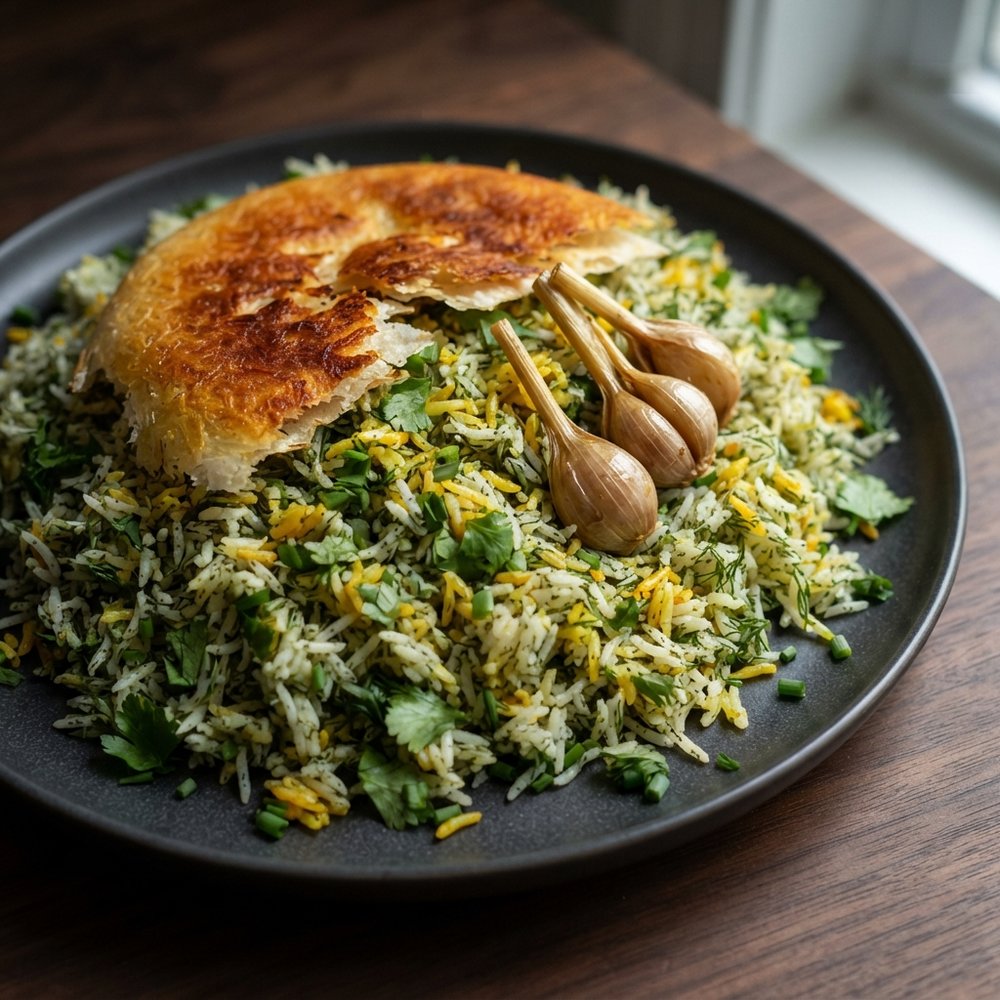
Sabzi Polo (Persian Herbed Rice) is aromatic and fresh, with fluffy basmati grains layered with parsley, cilantro, dill, and chives that perfume every bite. Threads of saffron add warmth and color, while a crispy lavash tahdig delivers a satisfying crunch. Serve it for celebrations like Nowruz or alongside grilled fish or kebabs for a vibrant dinner centerpiece.
- Prep35 mins
- Cook1 hr 20 mins
- Serves10
- DifficultyMedium
easyChef Pro health score
Calculated from USDA-referenced nutrient data for the ingredients in Sabzi Polo (Persian Herbed Rice), not estimated by an AI model. The same recipe returns the same score every time.
- Glycemic ImpactFair
- 56 / 100
- Carb quality, not quantity. Higher is better.
- Nutritional DensityPoor
- 0 / 100
- Nutrients per calorie. Higher is better.
- Energy DensityPoor
- 39 / 100
- Calories by weight. Higher means more food for fewer calories.
- NOVA Unprocessed or minimally processed
- 1 / 4
- Processing level, 1 (whole) to 4 (ultra-processed). Lower is better.
How it scores for each health goal
The same recipe scores differently against different goals, because the goal changes the calculation rather than filtering a list. Set your goal in easyChef Pro and every recipe is scored against it.
- 48
- Heart Health
- 57
- Metabolic
- 16
- Digestive
- 23
- Inflammatory
- 14
- Performance
- 28
- General Wellness
- 1
Put the rice in a medium bowl and cover it with lukewarm water. Gently swirl the rice with your finger to activate the starches, then tip the bowl to drain the water. Repeat until the water runs clear, about 7 rinses. Cover the rice with cold water, add 1 tablespoon salt, stir gently, and soak for 1 hour. Drain the rice without rinsing.
- 2
Grind the saffron threads to a powder in a small mortar and pestle. Move it to a small bowl with 2 tablespoons boiling water. Stir, cover, and set the saffron water aside.
- 3
Fill a 5-quart nonstick pot with 12 cups water and bring it to a boil over medium-high heat. Add 4 tablespoons salt and stir to dissolve. Add the rice, stir once gently, and watch closely so the water does not boil over. Taste for salt and add more if needed. Cook the rice until the first grain pops up to the surface. Set a timer for 4 minutes and continue cooking, skimming off any foam from the surface, until the timer goes off. Test the rice and keep cooking until it is tender on the outside but still firm to the bite inside, 6 to 8 minutes more.
- 4
Drain the rice in a colander and quickly rinse with lukewarm water using a spray faucet to remove extra starch. Taste the rice and gently rinse again if it is too salty. Set aside to drain completely. Wash and dry the pot.
- 5
Combine the parsley, cilantro, fresh dill, chives, and dried dill in a large bowl. Gently fold in the rice, taking care not to break the grains.
- 6
Set the clean pot over medium heat. Add oil, 1 tablespoon saffron water, and a pinch of salt; swirl to coat the bottom and lower sides with the oil mixture. Trim or tear the lavash bread and cover the bottom of the pot to form the tahdig layer.
- 7
Gently scatter the rice-herb mixture over the tahdig in a pyramid shape, ensuring the lavash is fully covered. Lay the garlic stalks on top at the outer edges of the rice. Carefully poke the handle of a wooden spoon into the rice a few times, avoiding the tahdig; this lets steam escape while cooking. Cover and cook until you see steam escaping from the edges of the lid and the tahdig begins to set, 10 to 13 minutes.
- 8
Meanwhile, mix 1/4 cup boiling water, melted butter, and the remaining saffron water in a small bowl. Lay a kitchen towel on a heatproof surface.
- 9
Check the tahdig by quickly tapping the side of the pot with a wooden spoon. When it sizzles, remove the pot from the heat. Take off the lid and place it on the kitchen towel, making sure no condensation drips into the pot. Wrap the towel around the lid and secure the ends at the handle so they do not hang near the heat source. Drizzle the butter mixture over the rice and cover with the towel-wrapped lid.
- 10
Set a heat diffuser on a burner over low or medium-low heat and return the pot to the stove. Cook until crispy, rotating the pot a few times, about 45 minutes. Remove from the heat and set on a damp kitchen towel; let sit, uncovered, for 5 minutes so the tahdig releases easily.
- 11
Serve the rice on a platter, garnish with the garlic stalks, and remove the tahdig whole or in pieces to serve on the side. Or invert carefully but quickly, like a cake, onto a serving platter.
- Calories 287.42 kcal Moderate 14%
- Protein 4.53 g Low Source 9%
- Carbohydrate 45.94 g 17%
- Total Fat 8.53 g Moderate 11%
- Saturated Fat 2.58 g Moderate 13%
- Trans Fat 0.0 g Low Source 0%
- Cholesterol 8.65 mg Low Source 3%
- Sodium 23.58 mg Low Source 1%
- Dietary Fiber 1.22 g Low Source 4%
- Total Sugars 0.43 g --
- Added Sugars 0.25 g Low Source 1%
- Calcium 41.29 mg Low Source 3%
- Iron 1.07 mg Low Source 6%
- Potassium 87.26 mg Low Source 2%
- Vitamin A 82.75 mcg Low Source 9%
- Vitamin C 15.6 mg Moderate 17%
- Vitamin D 0.0 mcg Low Source 0%
Values are per serving. Percent Daily Values are based on a 2,000-calorie diet.
- Milk 🥛
- Wheat 🌾
- Gluten
- Garlic 🧄
About This Recipe
Sabzi Polo (Persian Herbed Rice) is made with 12 ingredients and serves 10. It takes about 1 hr 55 mins and is rated medium. Key ingredients include Basmati Rice, Dried Dill, Fresh Chives, and Fresh Cilantro. Each serving provides about 287.42 kcal.
Recipe Questions
- What is Sabzi Polo (Persian Herbed Rice) made of?
- The main ingredients are Basmati Rice, Dried Dill, Fresh Chives, Fresh Cilantro, Fresh Dill. The full list of 12 is above.
- How long does it take to make Sabzi Polo (Persian Herbed Rice)?
- About 1 hr 55 mins in total: 35 mins to prepare and 1 hr 20 mins to cook.
- How many calories are in one serving?
- One serving provides about 287.42 kcal. The full nutrition breakdown is above.
- Is Sabzi Polo (Persian Herbed Rice) easy to make?
- This recipe is rated medium, with 12 ingredients and 11 steps.
- Is Sabzi Polo (Persian Herbed Rice) healthy?
- Sabzi Polo (Persian Herbed Rice) has an easyChef Pro health score of 36/100. Per serving, it provides 287.42 calories and 4.53 g of protein, or 9% of the Daily Value. Worth noting per serving: saturated fat at 2.58 g (13% of the Daily Value). It contains Milk, Wheat, Gluten and Garlic, so it may not be suitable for people with those allergies or dietary restrictions. Whether it fits your goals depends on your complete meal plan and nutritional needs. Remix it in easyChef Pro to adjust the ingredients and generate fresh nutrition and scores.
How easyChef Pro scores recipes and products
easyChef Pro analyzes up to 41 nutrients using data sourced from USDA and other verified food databases. Its scoring method uses the nutrients relevant to nutrition quality, calorie density, processing level, and your selected health goal. Recipes and food products get a health score from 0 to 100, calculated using consistent rules instead of being estimated by AI. The same nutrition data, serving size and health goal will produce the same result.
The calculation evaluates nutrients, calorie density, processing level, and how well the food supports your selected health goal. Protein, fiber, vitamins, minerals and other beneficial nutrients can strengthen the score. High amounts of sodium, saturated fat, added sugar and other nutrients may lower it.
Your health goal also matters. easyChef Pro evaluates recipes and products across six health areas and adjusts their importance for your selected goal. This means the same food may be a better fit for one health goal than another.
For recipes, changing an ingredient, quantity or serving size changes the nutrition and may change the score. Remix the recipe in easyChef Pro to calculate fresh nutrition and scores for the version you actually make. Product scores are based on the nutrition and serving information associated with that specific product.
Score a recipe free, no app required